Blueberry
Blueberry
Vaccinium corymbosum
📋Quick Facts
Height
1.5m
Spread
1.5m
Water
💧💧💧 Frequent watering
About
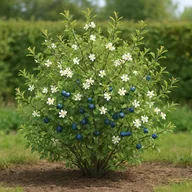
Plant blueberry bushes in ericaceous compost in containers, or in soil only if it tests acid (pH 4.5–5.5) — most UK gardens have neutral or alkaline soil where blueberries simply will not thrive. Blueberries are hardy (RHS H5–H6) and crop reliably for 20+ years if soil chemistry is right. Plant two different cultivars for proper cross-pollination and a heavier crop. Water with rainwater wherever possible — UK tap water is alkaline and gradually pushes the soil out of the acid range. Net the ripening fruit against blackbirds from late June. Pick when each berry pulls off the stalk with the lightest touch — that's the only fully-ripe test. Container culture in 40 cm pots of ericaceous compost is the practical UK approach for most gardens.
How to grow blueberry
- 1
Test your soil first (or skip to containers)
Blueberries need soil pH 4.5–5.5 — sharply acid. Most UK gardens are pH 6.5–7.5, which kills blueberries slowly through iron deficiency. Buy a £5 soil pH meter or kit. If your soil isn't acid, don't fight it — grow blueberries in pots of ericaceous compost.
- 2
Choose 40 cm containers and ericaceous compost
For non-acid soils, a 40 cm (or larger) pot of peat-free ericaceous compost per bush. Pots dry out quickly — bigger is better. Plastic pots hold moisture better than terracotta. Drainage holes essential — blueberries hate waterlogging but also wilt the moment they dry.
- 3
Pick two different cultivars
Most blueberries crop more heavily with a pollination partner of a different variety. Reliable UK pairings: Bluecrop (mid-season) + Patriot (early), or Duke (early) + Chandler (late). For container gardens, Top Hat is a dwarf form that pairs well with any standard cultivar. Some are listed as self-fertile but still crop better in a pair.
- 4
Plant the bushes
Container-grown blueberries plant any time of year; bare-root only from November to March. Set the rootball at the same depth as it was in the pot. Firm gently — blueberries are shallow-rooted, don't compact. Water in with rainwater.
- 5
Water with rainwater only (if you can)
UK tap water is alkaline. Watering with tap water gradually raises the pH of pot compost and starves the blueberry of iron, leading to yellow leaves with green veins (lime-induced chlorosis). Collect rainwater in a butt and use it for every watering. In a long drought, tap water is better than letting the plant wilt — switch back to rainwater as soon as you can.
- 6
Feed with ericaceous fertiliser in spring
A handful of ericaceous slow-release fertiliser around the base in April, top up in early June. Never use general-purpose feed — it's the wrong nutrient ratio and often makes the compost less acid.
- 7
Net against birds before berries ripen
Blackbirds will strip a bush in a single morning the day the first berries turn blue. Drape fine mesh netting over the bush from late June, or build a fruit cage. Tuck the mesh under at the base — blackbirds find any gap.
- 8
Prune from year 3 onwards
First two years: leave it alone, let the bush establish. From year 3: in February, remove the oldest, thickest, darkest stems at the base (one or two each year). Keep the bush full of younger, more vigorous wood — that's what carries the heaviest crops. Never give it a haircut.
Common questions
The blueberry year in your garden
How to Propagate
Hardiness Zones
USDA 6 equivalent