Apple
Apple
Malus domestica
📋Quick Facts
Height
4.0-5.0m
Spread
3.5-4.5m
Growth
🚀 Fast
Grows quickly, needs regular attention
Care Level
👍 Moderate
Some experience helpful
Water
💧💧💧 Frequent watering
Every "1-2" days
Hardiness
Zone 5-8
Cropping Timeline
Most grafted apples on semi-dwarfing rootstock like MM106 start bearing within three to four years. Dwarf rootstocks like M9 can fruit even sooner but need permanent staking. Pick off fruitlets in the first year or two to help the tree build strength — it really does pay off with heavier crops later. Some varieties like Bramley and Blenheim Orange are biennial bearers, so expect a bumper crop every other year. You will need at least two different varieties for cross-pollination, or a nearby crab apple will do the job.
About
Plant apple trees from November to March (bare-root) or year-round (container), in any decent garden soil with reasonable drainage and sun for at least half the day. Apples are very hardy (RHS H6) and crop reliably across the UK. The two decisions that matter most are rootstock (which controls eventual size — M27 for patio pots, M9 for cordons, MM106 for half-standards, M25 for traditional standards) and pollination group (most apples need a partner from the same flowering group). UK heritage varieties — Egremont Russet, Discovery, James Grieve, Bramley — outperform supermarket favourites in flavour and disease resistance. Prune in winter for shape; thin fruit in June for size; net or pick promptly to beat codling moth.
How to grow apple
- 1
Choose rootstock and variety
Rootstock controls eventual size: M27 (patio pot, 1.5 m), M9 (cordon or small bush, 2 m), MM106 (half-standard, 3–4 m), M25 (traditional standard, 5+ m). For UK conditions choose heritage varieties (Egremont Russet, Discovery, James Grieve) or modern disease-resistant cultivars (Red Falstaff, Saturn) over supermarket favourites that need spraying.
- 2
Check pollination group
Most apples need a pollinator from the same flowering group (1–7, where 3 and 4 are most common). Bramley is a triploid (needs two partners). A single apple tree on a small garden plot pollinates from neighbours' trees within 30 m; in a vacuum, pollination fails.
- 3
Plant
November to March (bare-root) is best; pot-grown can go in year-round. Dig a hole twice the rootball width. Set the graft union 5 cm above soil level (not below — burying the union defeats the rootstock's size control). Stake immediately to prevent rocking. Water in well.
- 4
Mulch and protect
Apply a 5 cm mulch of compost or wood chips, kept 5 cm clear of the stem. Protect the trunk with a spiral guard against rabbits and rodents.
- 5
Winter prune for shape
Each winter (December to February), prune to maintain an open goblet shape — remove crossing branches, water-shoots, and any branch growing into the centre. Aim for an open framework that lets light into the middle of the tree.
- 6
Thin fruit in June
After the natural June drop (when the tree sheds excess developing fruit in late June), thin further by hand. Leave 10–15 cm between fruits; remove the central king fruit on each cluster. Heavy crops left unthinned give masses of small poor-flavour apples and risk biennial bearing.
- 7
Watch for codling moth
Pheromone traps in May–June help reduce codling moth (the maggot in supermarket apples). Encouraging tits and other small birds is the best biological control. Pick fruit promptly when ripe — windfalls left on the ground harbour next year's pest.
- 8
Pick when ready
Test ripeness by cupping a fruit and twisting upwards gently. If it comes away easily with the stem, it's ready. Different varieties ripen at different times from August (Discovery) to October (Bramley, Egremont Russet). Store late varieties in a cool dark place — they keep for months.
Common questions
Pest Resilience
Apple scab, codling moth, and woolly aphid are common; regular monitoring needed.
Companion Planting
Visual Characteristics
Flowers
Blooms in Spring
Fruits
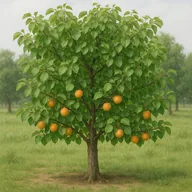
Harvest: Autumn / fall
Culinary
Fresh eating, pies, crumbles, cider, sauce, drying, butter
The apple year in your garden
How to Propagate
This plant produces viable seeds for propagation
🦋Wildlife & Garden Ecology
Great for supporting local pollinators and wildlife
Hardiness Zones
USDA 6 equivalent