Elder
Elder
Sambucus nigra
📋Quick Facts
Height
5.0-8.0m
Spread
4.0-6.0m
Cropping Timeline
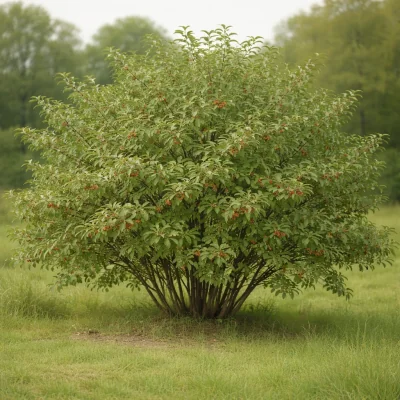
Elder is more of a large shrub than a true tree and is one of the fastest to fruit — you can expect flowers and berries within two years of planting, often in the first year from a good-sized plant. It grows vigorously in almost any soil and tolerates considerable neglect. The fragrant flowers make lovely cordial and fritters, while the berries are excellent for wine, syrup, and immune-boosting remedies. Do not eat the berries raw as they need cooking. Hard pruning in winter keeps it compact and productive.
About
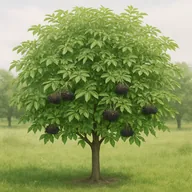
Plant elder bare-root from November to March, in sun or part shade, in almost any soil — it's a vigorous UK native shrub or small tree (3–6 m) that thrives in hedgerows, copses, and gardens with minimal care. Elder is very hardy (RHS H7) and produces frothy cream flower-heads in June (the source of elderflower cordial and champagne) followed by black berries in September (elderberry wine, syrup, jelly). Cooked berries only — raw elderberries cause stomach upset; cooking destroys the offending glycosides. The ornamental Black Lace cultivar has near-black foliage and pink-tinted flowers — a dramatic foliage shrub even if you never harvest. Cut hard back in winter for the strongest fresh growth and biggest flower-heads, but at the cost of fruit. Self-seeds via bird-dropped berries and from suckers — manage where it appears or it colonises gradually.
How to grow elder
- 1
Pick green-leaf or ornamental form
Common elder (Sambucus nigra): the UK native — green leaves, frothy cream flowers, black berries in autumn. The functional choice for flowers and fruit harvest. Grows 3–6 m, can be trained as a single-stemmed tree or multi-stem shrub. Black Lace (S. nigra Eva): near-black deeply-cut feathery foliage, pink-flushed flowers, dramatic in mixed borders. Less productive than the species but ornamental year-round. Aurea (golden-leaved): bright yellow-green foliage, classic UK garden form. Madonna: variegated green and cream leaves, ornamental but weak-growing. All four are Sambucus nigra cultivars and share cultivation requirements.
- 2
Plant bare-root in winter
November to March while dormant. Bare-root plants establish faster than container-grown and are much cheaper. Plant at the same depth the plant was in the nursery; water in deeply. Elder tolerates almost any soil except waterlogged ground, sun or part shade, exposure or shelter — it's a hedgerow toughie.
- 3
Allow space — 3 m radius minimum
Mature elder reaches 4–6 m wide and 3–6 m tall depending on pruning. Don't plant against a wall or path edge. The branches are brittle and break in autumn storms when laden with fruit — give it space to fall harmlessly. Multi-stem shrub forms are typical; train to a single trunk for a small ornamental tree if preferred.
- 4
Choose your pruning style
For flowers and fruit: prune lightly in winter, removing only dead, diseased, or crossing branches, and shorten the longest stems by a third. This preserves the older wood that bears the heaviest flowering and fruiting clusters. For dramatic foliage (especially Black Lace, Aurea): cut hard back to 30 cm above the base each February (coppicing). This sacrifices flowers and fruit but produces enormous, vivid leaves — the foliage-statement use of ornamental cultivars.
- 5
Harvest elderflowers in June
Pick flower-heads when the small individual flowers have just opened (the white shimmer is at peak), in dry weather, late morning after dew has evaporated. The musky-sweet scent is at its strongest then. For elderflower cordial: 30 heads, 1.5 kg sugar, 2 lemons (sliced), 50 g citric acid, 1.5 L boiling water — pour over, leave 24 hours, strain, bottle. Keeps 6 months in the fridge.
- 6
Harvest elderberries in September
Pick the entire umbel cluster when the berries are fully black and the whole head droops with weight. Snip the stem with secateurs. Strip the berries off the stems with a fork over a bowl (the stems contain toxic glycosides — discard them). Use straight away or freeze on trays for later cordial, wine, or syrup making.
- 7
NEVER eat elderberries raw
Important. Raw elderberries (and the stems, leaves, and bark of elder) contain cyanogenic glycosides that cause nausea, vomiting, and stomach upset. Cooking destroys the glycosides — heat the berries to a boil for at least 30 seconds before any use. Cordials, syrups, jellies, wines all involve cooking that makes the berries safe. Don't eat them straight off the bush, however good they look.
- 8
Manage self-seeding
Elder is bird-distributed — robins, blackbirds, thrushes eat the berries and deposit seed widely. New elder plants appear in hedges, fence corners, and garden edges within 3–4 years. Pull young seedlings while small (1–2 years old) or let one establish as part of a wildlife corner. Old elders sucker from the base — dig out unwanted suckers in winter.
Common questions
Pest Resilience
Very few pests; elder aphid may cluster on shoots but rarely causes lasting damage.
Visual Characteristics
Culinary
Elderflower cordial, elderflower champagne, fritters, syrups, elderberry jelly, elderberry wine, infused vinegar
The elder year in your garden
How to Propagate
Hardiness Zones
USDA 4–5 equivalent