Hazelnut / Filbert
Hazelnut / Filbert
Corylus avellana
📋Quick Facts
Height
4.0-6.0m
Spread
3.5-5.0m
Cropping Timeline
Hazels are among the quickest nuts to crop, with grafted cultivars often producing a first handful of nuts within three to four years. They are wind-pollinated and you will need two different varieties that flower at the same time — the catkins need to overlap with the tiny red female flowers. Kentish Cob and Cosford are a classic pairing. Squirrels are your biggest challenge; they strip the nuts weeks before you think they are ready. Traditional coppicing or annual pruning of suckers keeps plants productive and manageable.
About
Plant hazelnut bushes bare-root from November to March, in sun or part shade, in well-drained soil — they're a vigorous UK native shrub or small tree (4–6 m), traditional source of cobnuts and filberts, and equally valuable as a coppice plant for poles and beanpoles. Hazel is very hardy (RHS H6), thrives in almost any soil except waterlogged ground, and pollinates by wind in February when the lambs-tail catkins shed pollen onto the tiny red female flowers. Plant at least two different varieties for cross-pollination — most cobnuts and filberts are not self-fertile. Grey squirrels are the dominant pest — they take nuts unripe in August, before you'd think to harvest. Kentish Cob and Cosford are the classic UK varieties. Coppice every 7–10 years for harvest of straight 2 m hazel poles (peas, beans, garden structures).
How to grow hazelnut / filbert
- 1
Choose nut-cropping or coppice form
Nut-cropping: plant named varieties for big yields of edible nuts. Kentish Cob (the UK standard cobnut), Cosford (medium oval nut, easy to crack), Butler (modern, heavy cropping), Halle's Giant (very large filbert nut). Plant 2–3 different varieties for cross-pollination. Coppice form: plant the wild UK species (Corylus avellana unselected) for traditional coppicing — cut to ground every 7–10 years for straight 2 m hazel poles useful for pea/bean sticks, garden structures, hurdles. Grown on a coppice cycle, the same stool produces poles for 200+ years.
- 2
Plant at least two for pollination
Hazels are wind-pollinated and most varieties are self-incompatible — they need pollen from a different cultivar. Kentish Cob + Cosford is the classic UK pairing — both crop heavily and pollinate each other. Butler + Ennis is the modern combination. A single hazel bush flowers and produces catkins but sets few or no nuts. The pollination range is wide (50+ m), so a neighbour's hazel may already be doing the job.
- 3
Plant bare-root in winter
November to March while dormant. Bare-root plants establish faster and cheaper than container-grown. Spacing 4–5 m apart for nut-cropping bushes; 1.5 m for coppice rows. Plant at the same depth as the nursery; water in. Hazel tolerates almost any soil — chalky, acid, sandy, clay (provided drainage), exposed or sheltered.
- 4
Train as a bush or a stool
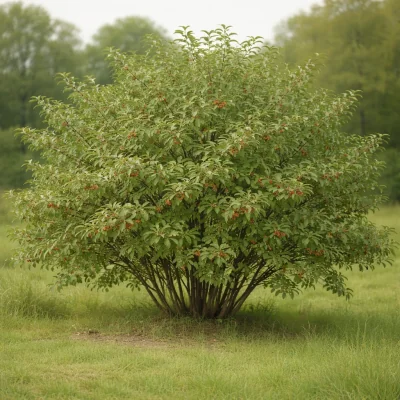
Bush form for nut-cropping: maintain 6–8 main stems rising from near ground level, removing suckers and crossing branches each winter. Mature bushes 3–5 m tall by 4 m wide. Coppice stool for poles: cut every stem to the ground (a stool 10–15 cm above soil) every 7–10 years in winter. Each stool re-grows a thicket of straight new poles. Productive stools last 200+ years.
- 5
Light prune in winter for nut-cropping bushes
February is the only pruning window — hazel flowers in February (the catkins) and pruning later removes the flowers and the crop. Each winter: remove dead, diseased, crossing branches; thin overcrowded growth to maintain the bush shape; shorten over-vigorous shoots. Keep the centre open for airflow.
- 6
Defend against squirrels — the dominant pest
Grey squirrels strip unripe nuts in August, before they've fully matured. This is the single biggest reason garden hazels fail to crop. Three defences. (1) Pick nuts as soon as they reach full size and the husks start to brown (early August) — even if not fully ripe, they'll dry indoors. (2) Net the bush with fine mesh during August (works for small hazels). (3) Live-trap squirrels under licence (UK law restricts release after capture — humane dispatch only). Walk-in fruit cages keep them out permanently.
- 7
Pick nuts in August–September
Cobnuts (Kentish Cob) ripen from early August. The husk that surrounds each nut turns brown at the edges as the kernel inside reaches full size. Pick nuts before they fall — fallen nuts get eaten by wildlife within hours. Strip the husks off, spread the nuts on a tray to dry in a warm dry place for 2–3 weeks. Store in a dry, cool, vermin-proof place. They keep 6+ months.
- 8
Coppice cycle for hazel poles (if grown for wood)
Every 7–10 years in winter (December–February), cut every stem on the stool down to 10–15 cm. The stool re-shoots vigorously the following spring with a thicket of straight young poles. After 3–4 years they're useful for pea/bean sticks (1.5 m), after 7 years for beanpoles and structural canes (2.5 m), after 10 years for hedge laying. Stagger coppicing across multiple plants if you want a continuous supply.
Common questions
Pest Resilience
Nut weevil and squirrels are the main problems; big bud mite occasionally.
Visual Characteristics
Culinary
Raw snacking, roasting, praline, nut butter, baking, dukkah, oil pressing
The hazelnut / filbert year in your garden
How to Propagate
Hardiness Zones
USDA 5 equivalent